The Masks I Wear

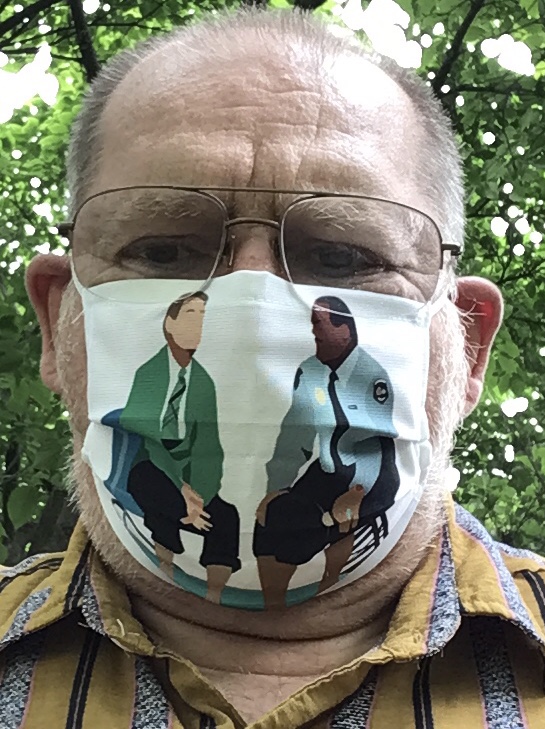
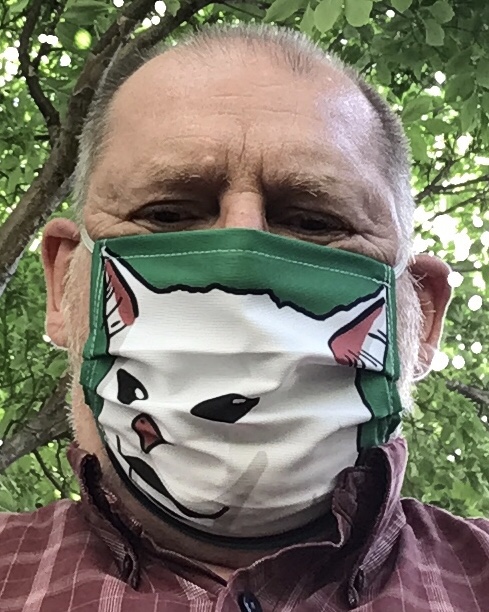
The pandemic has provided us with a new form of self-expression … the face mask. Here are a few that I wear.

The first mask depicts Fred Rogers and François Clemmons recreating a scene from Mister Rogers Neighborhood. On a summer day, Mr. Rogers invites Officer Clemmons to join him in cooling off his feet in a kiddie pool. This link explains the significance of this scene.

The second mask is Smudge, the white kitty that always has a snappy comeback for screaming Karen. Because I like to dispense snark on occasion.

The third mask probably doesn’t need an explanation. Bernie won the internet on Inauguration Day when this photo went viral.

The fourth mask is a photo I took of a red panda. At first I called the red panda my spirit animal, but a friend reminded me that was cultural appropriation. So I’ll call it my patronus.

The last mask is an alternate logo for the Rochester Red Wings baseball team. They play in the Triple A East league (formerly the International League) and are affiliated with the Washington Nationals. The symbol in the center is the logo for the city of Rochester NY, known as the Flower City/Flour City.

An American Hero

One of my springtime rituals is to watch Ken Burn’s “Baseball” documentary in anticipation of the baseball season. The documentary is structured into innings that cover individual decades. Last night, I watched the 1940s disc, much of which is devoted to Jackie Robinson and his historic breaking of Major League Baseball’s color barrier.

The Brooklyn Dodgers’ owner Branch Rickey gave much thought to choosing the right player to integrate the game. There were many talented players in the Negro Leagues, but he needed someone who could maintain his composure when faced with the inevitable hostility they would experience. Although Jackie Robinson had a temper, he was up to the task of not responding with anger to the verbal and physical attacks. He had pitchers throw beanballs at his head and runners intentionally spike his leg when he covered first base. Not to mention piles of death threats.

Jackie won this battle using a powerful combination of character and athletic ability. He won over teammates who were hesitant by his spectacular play and leadership as they successfully won the pennant. Fortunately, he was judged on his ability and won over the hearts of America’s baseball fans. After two seasons of turning the other cheek, Branch Rickey gave him permission to be more outspoken.

His position as a trailblazer did take a physical toll and he retired after 10 seasons with the Dodgers, who later moved to Los Angeles. The iconic play of his career was in the first game of the 1955 World Series when he stole home. The Dodgers finally won the series against the Yankees that year.

He spent his post-baseball career as a civil rights leader. This is covered in the second part of Ken Burns documentary Jackie Robinson. In 2013, actor Chadwick Boseman captured his story in the biopic 42. Major League Baseball retired his number and each year on April 15th, everyone on the field wears the number 42.

Voting Rights in an Equality Issue

One of the principles of democracy is one person, one vote. However, the United States has a structural problem that the Founders did not anticipate. The vote of a Wyomingite carries more weight than a Californian because of the small-state bias of the Senate and the Electoral College. And the residents of the District of Columbia do not have voting representation in Congress.

A hard truth about American politics is that we have a two-party, winner-take-all system with one party that wants to expand democracy and another that wants to restrict it. I know, I know, our country is a constitutional republic not a democracy. The folks who want less democracy like to remind of us of that.

I often wonder what is the bigger threat to democracy: voter apathy or voter suppression? Those who want to restrict democracy cling to the fallacy that there is rampant voter fraud. Fortunately, the review of the 2020 election by the government agencies that ran it found little evidence of fraud.

The politicians who want to restrict voting rights were unable to win elections by promoting better ideas, so they resort to choosing their voters. In addition to gerrymandering, they are trying all types of tactics: excessively strict ID and signature requirements, reduced voting hours and early voting, restrictions on absentee voting, and limited voting locations resulting in long lines.

These voter suppression tactics are targeted at poor people, black and brown people, students and the elderly. Do we ever see long lines of voters in affluent neighborhoods? Welcome to Jim Crow 2.0!

Everyone who is eligible to vote should have equal access to the polls. But the architects of voter suppression are determined to prevent democracy from happening again. Hand me my blood pressure meds!

Infinite Growth on a Finite Planet

“We have a finite environment—the planet. Anyone who thinks that you can have infinite growth in a finite environment is either a madman or an economist.” – David Attenborough

https://www.goodreads.com/quotes/10060198-we-have-a-finite-environment-the-planet-anyone-who-thinks-that

Economists like to remind us that the economy is not a zero-sum game in which for someone to win, someone else has to lose. An exception to this might be Manhattan real estate, in which the Former Guy purportedly made his fortune. 🙂 Practitioners of the dismal science tell us that we can continue to make a bigger pie and keep on growing. But there are definite limits and that’s where sustainability comes in.

Sustainability means meeting our own needs without compromising the ability of future generations to meet their own needs. In addition to managing natural resources, this will involve economic and social resources as well. In other words, sustainability is about profit, people, and planet.

I like to paraphrase a verse from the Bible: “The love of money, that is, the pursuit of profit without regard for people or planet, is the root of all evil.”

The good folks at the United Nations have given this much thought, and in 2015 came up with a blueprint of 17 sustainability goals:

  1. No poverty
  2. Zero hunger
  3. Good health and well-being
  4. Quality education
  5. Gender equality
  6. Clean water and sanitation
  7. Affordable and clean energy
  8. Decent work and economic growth
  9. Industry, innovation, and infrastructure
  10. Reduced inequalities
  11. Sustainable cities and communities
  12. Responsible consumption and production
  13. Climate action
  14. Life below water
  15. Life on land
  16. Peace, justice, and strong institutions
  17. Partnerships for the goals.

I have to admit that these are very lofty goals and will require a lot of cooperation at the individual, community, national, and international levels. To achieve them will require a paradigm shift from YOYO (You’re on your own) to WITT (We’re in this together).

A Pecking Order that Needs to Be Shaken Up

An author that has influenced my worldview is linguist/cognitive scientist George Lakoff. Two of his books are Moral Politics and Don’t Think of an Elephant. Both books explore the differences in how liberals and conservative think and provide recommendations on how to frame political arguments.

One of the metaphors that Lakoff uses is the “strict father” and “nurturing parent” models of political thought. The strict father model is mostly associated with conservative ideology while the nurturing parent model is mostly associated with liberal ideology. Of course, most people employ a mixture of these two models depending on the situation.

In American politics, the left seems to focus on policy while the right seems to focus on marketing their ideas, which may be why they are successful at stifling the will of the majority. Words really do matter and bumper sticker slogans usually trump nuanced policy proposals.

Lakoff describes the following moral hierarchy based on the strict father worldview:

The basic idea is that authority is justified by morality (the strict father version), and that, in a well-ordered world, there should be (and traditionally has been) a moral hierarchy in which those who have traditionally dominated should dominate. The hierarchy is: God above Man, Man above Nature, The Disciplined (Strong) above the Undisciplined (Weak), The Rich above the Poor, Employers above Employees, Adults above Children, Western culture above other cultures, America above other countries. The hierarchy extends to: Men above women, Whites above Nonwhites, Christians above non-Christians, Straights above Gays.

https://georgelakoff.com/2016/07/23/understanding-trump-2/

Most people will agree with a few of these: God above Man (for people of faith) and Adults above Children. But since I believe in bending the arc of history towards justice, most of this pecking order needs to be shaken up.

Economics for the Rest of Us 101

So you want to learn more about economic justice but don’t know where to start? Here are a couple of suggestions.

The work of Robert Reich. He’s a little guy who looks out for the little guy and makes the principles of a just economy easy to understand. Check out his documentary Inequality for All and his very accessible introductory book Economics in Wonderland (with cartoons). He also has many short explainer videos (with doodles) on his YouTube channel.

The Economic Policy Institute. EPI is a Washington DC think tank (Robert Reich was one of the founders) that advocates for working families. Here is a link to their policy agenda.

Dollars & Sense magazine and books. Dollars & Sense: Real World Economics is an organization that “publishes economic news and analysis, with the mission of explaining essential economic concepts by placing them in their real-world context”. In other words, the economy that happens on Main Street, not Wall Street.

Oh, and by the way, just a reminder, the stock market is not the economy. I’m still trying to find out which Indian tribe runs it. 🙂

Green Party Values

A few years ago, I took an online quiz that helped to determine which political party was closest to my views. My positions were closest to the Green Party at around 98% followed by the Democratic Party at around 90%. I did a little research and found that the Green Party has a list of Ten Key Values. These are:

  • Grassroots Democracy
  • Social Justice & Equal Opportunity
  • Ecological Wisdom
  • Non-Violence
  • Decentralization
  • Community-Based Economics
  • Feminism & Gender Equity
  • Respect for Diversity
  • Personal & Global Responsibility
  • Future Focus & Sustainability

Their party platform also has four pillars: Peace, Ecology, Social Justice, and Democracy.

Sign me up!

One problem though. Unlike other developed nations that have parliamentary systems with proportional representation, the United States has a two-party winner-take-all system. So instead of voting for a party that is closest to my values, I end up aligning myself with a party that represents most of my values.

When there is a Green candidate on the ballot, I will vote for them as long as it won’t harm the better candidate of the two major parties. The Green Party acted as a spoiler in two close presidential elections: 2000 and 2016.

In New York state, the Green Party used to get automatic ballot status for four years if their candidate received 50,000 votes in the gubernatorial election. Last year, New York changed its election laws so that a party needs to garner 130,000 votes of 2% of the total votes cast, which ever is higher, to remain on the ballot.

So for now, New Yorkers will have less choice in the voting booth.

One Step Further

You may have seen the meme that illustrates the difference between equality and equity in one of its many variations. You know the one with the three children of different heights standing on boxes to look over a fence and watch a ball game.

In the first panel labelled Equality, each child has a box. This scenario is based on equal treatment and the assumption that everyone benefits from the same supports. Some people might even call this fairness. Except it is not fair to the shortest child who can’t look over the fence to see the game.

The second panel is labelled Equity and the shortest child gets a second box and is able to watch the game. In this scenario, everyone gets the support they need and it appears that the playing field is level. However, some may assume that the second box was taken from the tallest child (who in reality doesn’t need it) and this could be a source of resentment.

In the real world, neither of these scenarios exist because the distribution problem has not been solved. Although there is the fundamental American belief that all men people are created equal, we haven’t even reached the first stage where everyone has a box, let alone made progress on creating a level playing field.

But there is a third scenario which takes things one step further but requires some out-of-the-box thinking. And that is addressing the cause of the inequity and removing the barrier. Another name for tearing down this wall is justice.

There is an aphorism frequently used by John F. Kennedy and later by Ronald Reagan that a “rising tide lifts all boats”. There is some truth to this saying, but in our efforts to broaden prosperity, we need to remember that some people’s boats are not seaworthy and some don’t have boats at all.

Welcome

This blog is about what I call the three E’s: equity, environment, and economic justice, which are three mega-categories of issues that I care about. At this point in history, our country is in a crisis as we battle a pandemic. The pressing need is to slow the virus so that our lives can return to normal, while at the same time providing economic assistance to those facing devastation from loss of income, and in the worst cases, lack of food, shelter, and the necessities of life.

The pandemic has affected all of us differently, without rhyme or reason. Some of us are essential workers and have faced a higher health risk as we provide necessary services to others. Some of us have lost employment as things that give us pleasure, such as movies, sports, arts, and social activities have shut down. Some of us have been fortunate enough to have employment where we can continue to work remotely. Those of us who are affluent have benefited from economic gains in the stock market. But just a reminder: The stock market is not the economy.

In the background of the pandemic and economic hardship are two other crises that still need to be addressed: climate change and systemic racism. We are polarized nation where some are still climate change deniers, in spite of more frequent catastrophic events. Some of us believe that we are a post-racial society where there is equal opportunity for everyone … if they only work hard enough.

As you can probably guess, I hold a progressive worldview. Some of my fellow citizens on the right end of the political spectrum feel that our nation has achieved its ideals and “if it isn’t broke, don’t fix it”. I’m in the camp that feels that our nation still has a way to go to achieve its ideals and working toward building a more equitable society is patriotic.

My blog posts may touch on some sensitive issues and I will strive to express my opinions in a civil and respectful way. But I am also known for dispensing snark, so stay tuned. 🙂