Creation Care

Last Sunday in church, our congregation celebrated Earth Day as we do each year. Some Christians believe humanity was given the Biblical imperative of dominion over the earth. Personally I believe that this means the responsibility of being stewards of the earth, caretakers of the big blue marble.

And God said “Let us make humankind in our image, to be like us. Let them be stewards of the fish in the sea, the birds of the air, the cattle, the wild animals, and everything that crawls on the ground.

Genesis 1:26 – The Inclusive Bible. The First Egalitarian Translation

The problem with the belief in dominion over the earth is that the greedy among treat it as a carte blanche. Keep on extracting resources through activities such as strip mining and deforestation. Keep on producing our food supply through factory farming and inhumane treatment of livestock. Keep on packaging products with unnecessary amounts of wasteful materials. Yes, we need things but there are sustainable ways to produce them with minimal harm.

In her book and website, The Story of Stuff, environmental activist Annie Leonard reminds us that there is no such place as Away. We need to be more conscious in our consumer choices. Reduce, reuse, recycle, repurpose.

The first Earth Day was over 50 years ago and we can look back at the progress that we have made. Our air and our water is cleaner but care for our planet is a continuous process. As Kermit the Frog sang “It Isn’t Easy Being Green”, but there are a lot of small things we can do with conscious effort.

When the last tree is cut, the last fish is caught, and the last river is polluted; when to breathe the air is sickening, you will realize, too late, that wealth is not in bank accounts and that you can’t eat money.

Alanis Obomsawin, an Abenaki from the Odanak reserve, seventy odd miles northeast of Montreal.
DEI is Good for Business

My professional society had a workshop today with a theme of Diversity, Equity, and Inclusion. DEI is a hot topic today in the world of business. Some of the advantages of an inclusive culture at work are:

  • better performance
  • increased customer understanding
  • better decision making
  • new ideas
  • stronger governance

Some of the traits of an inclusive leader are:

  • commitment
  • courage
  • cognizance of bias
  • curiosity
  • cultural intelligence
  • collaboration

For me, the highlight of the afternoon was a video entitled “Inclusion Starts With I.”

Less Code = Less Carbon

At a conference that I attended yesterday, the keynote was on sustainability. One of the topics that was an eye opener for me was the energy required for our digital life. I’ve heard about the amount of energy required to mine cryptocurrency but did not understand it. Heck, I’m trying to figure out which Indian tribe runs Coinbase. 🙂

What this means is there is a need to reduce the file sizes of digital media that we send to other people. Do we need to send high-resolution photos when a lower resolution will look the same to most people? Do we need to send a graphical memento of appreciation when a thank you email will do? Do you really need to post that video?

There is no problem with large files if they are stored locally. But when they are stored in the cloud, your carbon footprint increases. I’m not sure how much of an impact my digital life has on my carbon footprint. I also wonder how the carbon footprint of data is calculated. It’s a small portion but also significant because the digital life of several billion data users adds up.

It is estimated that data centers use about 1% of electricity and transferring 1 GB of data produces 3 kg of CO2.

Social Democrat vs. Democratic Socialist

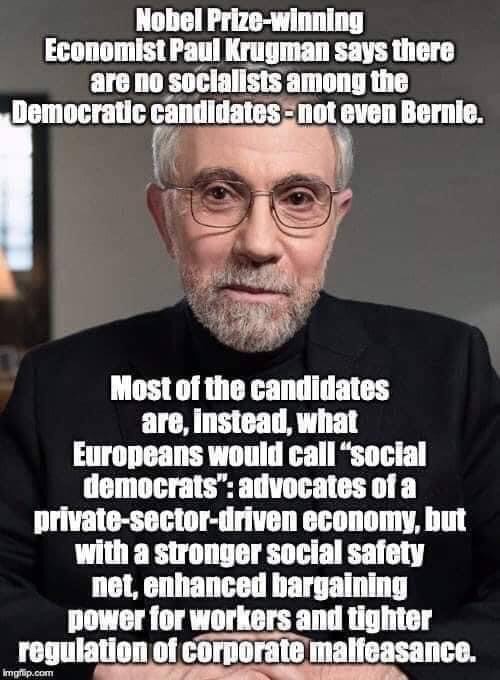
I recently saw the following meme which closely expresses my point of view on economics and politics:

I’m a fan of Senator Bernie Sanders and Representative Alexandria Ocasio-Cortez and consider them to be important voices in today’s political scene. Even though I mostly share their vision, I’m not comfortable with the label Democratic Socialist. I understand what they mean by it, but also see it as a lightning rod for criticism. To many millennials in Bernie and AOC’s base, democratic socialism brings to mind the Nordic countries, but to many in my generation who are more conservative, socialism brings to mind Cuba and Venezuela. These folks don’t hear the democratic part.

I prefer the term social democrat and the characteristics that Prof. Krugman mentions:

  • private sector-driven economy
  • stronger social safety net
  • enhanced bargaining power for workers
  • tighter regulation of corporate malfeasance

The Nordic countries have a secret sauce that makes them some of the happiest countries in the world. They have vibrant capitalist economies AND a strong safety net. Yes, they have higher taxes than the United States, but their citizens get more in return for their taxes.

In the three decades after World War II, there was more of a counterbalance between labor and capital, and between corporations and the public interest. Then around 1980, these scales were tipped by anti-union sentiment, deregulation, and tax cuts. Neoliberalism shoved aside Keynesian economics and started the trend towards extreme inequality.

I believe the four elements of social democracy are the secret sauce to a happier society built on the common good. And if coupled with the triple bottom line of profit, people, and planet will lead to a brighter future.

An Epidemic of Hate

Throughout our country’s history, certain groups of people have been discriminated against. In particular, immigrant communities bear the brunt of being the other. In the mid-19th century, it was “No Irish need apply”. Around the turn of the century, it was immigrants from Southern and Eastern Europe. For a century after the Civil War, blacks experienced Jim Crow. After 9/11, Muslims were treated with suspicion.

In some cases, ethic groups assimilated and became part of the tossed salad of American life. In other cases, discrimination has evolved into outright hate and has intensified as our society has become hyper-polarized. Two communities that are more recent targets are Asian-American and Pacific Islanders (AAPI) who are falsely being blamed for the Covid pandemic and LGBQT+ (especially trans youth).

One of the organizations I support is the Southern Poverty Law Center. The maintain a database of hate groups which has expanded over the last five years. Most of the groups would be described as alt-right with various anti-black, anti-Muslim, anti-Semitic, and anti-LGBTQ sentiments. Two of the groups behind the January 6th insurrection, the Proud Boys and the Oath Keepers have been designated as hate groups by SPLC. Note that Black Lives Matter and the bogeyman called “Antifa”, which is not even an organized entity, are not designated as hate groups.

Like many Americans, I long for national unity and am saddened by the alternate universes that we live in. We mostly consume media that we agree with, without testing it for confirmation bias or false equivalency. As a nation, we are recovering from the Big Lie and it’s going to take awhile to repair the breach. But in the end, I believe that truth will prevail and the arc of history will bend towards justice.

Update: After I wrote this post, the Washington Post published an analysis on domestic terrorism. The article includes a link to a report highlighting the involvement of former and current members of the military and police in domestic terrorism.

Ask the GINI

As a thought experiment, I sometimes ask myself if I had a magic lamp, what advice might I give to myself as a young adult. I would say explore the world and find the country that is closest to your values, learn the language if necessary, and move there. Most likely, I would be an expat because the United States is way too individualistic for the common good. Because Americans are so adverse to taxation and spend so much on being a military power, we don’t have some of the good things that other developed countries enjoy.

The United States is a land of extreme inequality with both extreme wealth and one of the highest poverty rates of the developed countries in the Organization for Economic Cooperation Development (OECD). Only Costa Rica is higher.

One way to compare inequality between countries is the GINI coefficient. The mathematical formulas are complex, but in a nutshell, 0 is complete equality and 1 is complete inequality. About half the countries in the OECD have a GINI index of 0.30 or less. The US has one of the highest at 0.39. Note that several organizations such as the World Bank and the CIA track the GINI index of various countries and they use data from different years. But it’s not like comparing apples and oranges; it’s more like comparing honey crisp and red delicious.

Another ranking that I follow each year is the World Happiness Report. I looked up the ranking of the 10 happiest countries and their GINI index. Here is the list along with the GINI index provided by the World Bank:

  1. Finland 27.4
  2. Denmark 28,7
  3. Switzerland 32.7
  4. Iceland 26.8
  5. Norway 27.0
  6. The Netherlands 28.5
  7. New Zealand –
  8. Austria 29.7
  9. Luxembourg 34.9
  10. Canada 33.8

The United States came in at #18 with a GINI of 41.4 and Mexico at #24 with 45.9.

Of course, this is not enough data to draw a conclusion but it looks like the happier countries have lower inequality,

For further reading on how economic equality improves social outcomes, see The Spirit Level: Why More Equal Societies Almost Always Do Better and The Equality Trust website.

A Loss for Labor

I’m disappointed about the union vote at Amazon’s Bessemer warehouse in Alabama. While it’s true that Amazon pays its workers $15 an hour and offers health benefits, the working conditions leave a lot to be desired. The rapid pace expected of the workers could result in unsafe working conditions and who wants to have to pee in a bottle?

Amazon pulled out all the stops in their anti-union campaign with emails and posters in the bathroom and mandatory meetings with anti-union propaganda. They violated labor laws by firing union activists. But I guess the vote shouldn’t be a surprise because Alabama is a right-to-work (for less) state. In a nutshell, Amazon coerced its employees to vote against their interests.

Prior to the 1980s, labor was a counterbalance to capital and most Americans enjoyed a middle-class lifestyle. Then Reagan’s response to the PATCO strike dealt a blow to the labor movement and ushered in an era of anti-labor sentiment.

I’m scratching my head at why people are against labor unions. Organized labor gave us the weekend, paid vacations, and the other perks that we enjoy. Because of the labor movement, children no longer work in coal mines and textile mills. Some companies even offered great pay and benefits to keep workers from unionizing.

On a personal note, I’m grateful that my daughter belongs to a union. Although I have a great job with competitive benefits, I’m jealous of the perks that she receives.

A Profile in Courage

March 31st is International Transgender Day of Visibility, a day dedicated to celebrating transgender people and raising awareness of the discrimination that they face. I have a Facebook friend who is transitioning and I have been following her posts as she describes the physical changes as well as practical matters such as legally changing her name. In short, I am inspired by her path to becoming her authentic self.

I am part of the boomer generation and she is a millennial, so the process of transitioning is more commonplace than when I was her age. The societal barriers are coming down as the understanding of gender identity, gender expression, and sexual orientation is increasing. I am a cisgender, heterosexual male and strive to be an LGBTQ+ ally and I am learning a lot of new terminology. Here is a quick guide for those who seek to understand the spectrum of gender and sexuality.

Gender identity starts in the brain and most of us experience a good fit with the gender assigned to us at birth. We accept the gender roles that society has established and are not conflicted about gender expression. But for others, these roles don’t feel quite right and they struggle with gender dysphoria. I can only imagine how difficult it must be to make the decision to transition.

I admire the courage of my Facebook friend and appreciate her first person account. There is so much discrimination, including physical danger, against trans people. Fortunately my friend lives in an area where there is greater acceptance of LGBTQ+ folx and I am inspired as she talks about the burden that has been lifted as she is able to live according to her true gender expression.

Some people object to the gender expression of trans people on religious grounds. Here is a beautiful cartoon that expresses a compassionate answer.

Get the ERA Passed

The Equal Rights Amendment is a proposed amendment to the United States Constitution designed to guarantee equal legal rights for all American citizens regardless of sex. It seeks to end the legal distinctions between men and women in terms of divorce, property, employment, and other matters.

“Equality of rights under the law shall not be denied or abridged by the United States or by any state on account of sex.”

Text of the Equal Rights Amendment passed by Congress in 1972

The Equal Rights Amendment was first drafted by Alice Paul and was introduced in every Congress since 1923. It started to gain momentum in the 1970s due to the women’s movement and in 1972 passed both houses of Congress by the necessary two-thirds supermajority. Then it was sent to the states for ratification with a deadline of 1977, which was later extended to 1982. By the time the deadline expired, 35 states states had ratified it, three states short of the required three-fourths majority.

The text of the amendment is straightforward. Who could disagree with it? What happened??

The ERA ran into opposition from the nascent religious right movement led by Phyllis Schlafly. The STOP ERA campaign used the bogeymen of gender-neutral bathrooms, same-sex marriage, and women in combat, which was enough to derail the amendment.

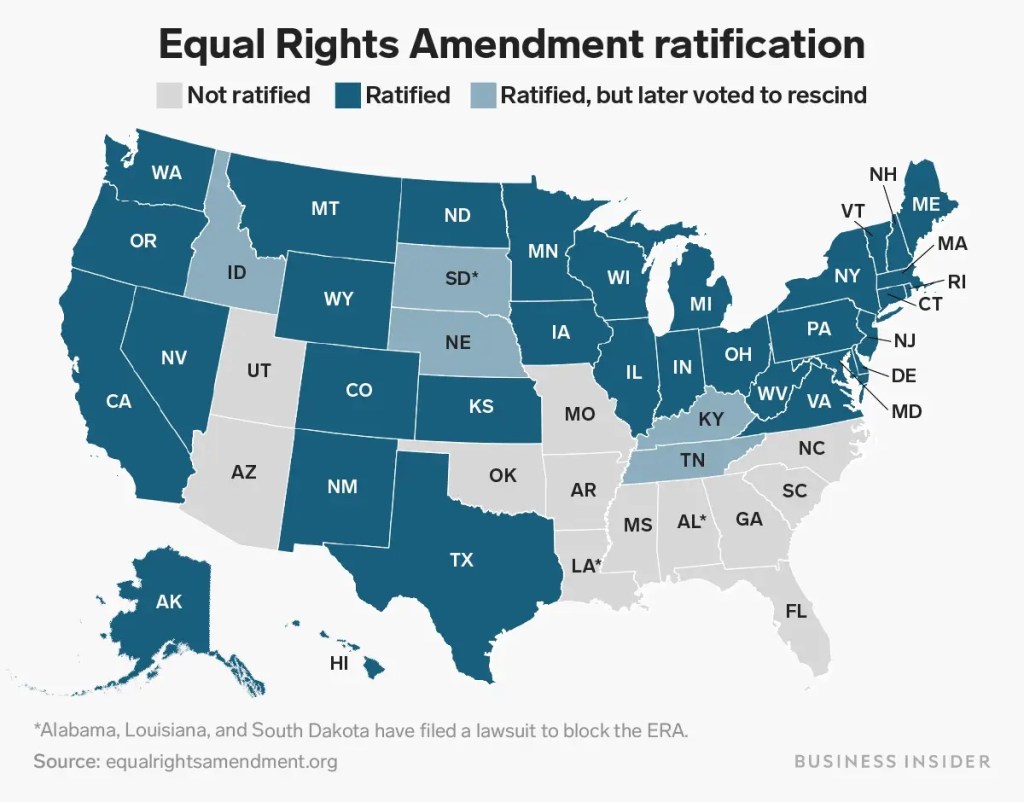
In 2017, Nevada became the first state to ratify the ERA since 1977. Illinois followed suit in 2018. On January 15, 2020, Virginia became the 38th state. But the legal question is, can Congress roll back the 1982 deadline?

On March 17th of this year, the House of Representatives voted to remove the expired deadline. Now it must get past the legislative graveyard called the Senate. And then the fight begins to win back the five states that rescinded their ratification.

Times have changed since the 1970s, but some parts of the country want to set the clock back to the 1950s to the way things were before the women’s movement. And it’s definitely a regional thing.

Like many progressives, I admire the late Supreme Court Justice Ruth Bader Ginsburg. My daughter gave me action figure of her which I keep on my desk. No one has done more for the rights of woman than the Justice Ginsburg. In honor of her, I hope that the ERA finally gets passed. Then we can have a dance party on Phyllis Schlafly’s grave.

How Bad is Wealth Inequality?

Back in 2013, a video that provided a visualization of wealth in America went viral. Imagine one hundred Americans standing on a football field, one yard apart from each other, arranged from poorest to richest. They represent income percentiles. Now visualize each person’s wealth as a stack of $100 bills. The stack starts out very small, then grows slowly for the next 80 yards. Then something starts to happen. The stacks begin to grow higher and then take off in an exponential fashion around the 1 yard line. Just take a moment to watch the video.

The video also shows a graphic from a survey that compares what Americans think the distribution of wealth is in quintiles, along with what they think the ideal distribution should be, and what is actually is.

https://www.motherjones.com/politics/2011/02/income-inequality-in-america-chart-graph/

Now an equal distribution of wealth is not possible, nor even desirable. Some people are more ambitious and work harder and should be rewarded for their effort. But it is a sad reflection on our country, that a land with so much wealth also has one of the highest levels of poverty among the developed nations.

Forty years ago, the distribution was closer to the middle graph of what Americans think it is. But one thing is for certain, after four decades of upward redistribution of wealth, our nation has not been moving in the direction of a more just economy.